Teachers Act Up!

Thoughts on Teaching, Language, and Social Change from Melisa "Misha" Cahnmann-Taylor

Teachers Tell All: Theatre for Social Change in Our Educational Communities”

Teachers Tell All: Theatre for Social Change in Our Educational Communities”

When I decided to teach two summer school courses–one poetry course for creative educators and one theatre course for reflective language practice–I don’t think I knew what I was getting myself and my students and colleagues into.  Summer courses are always compressed, fast-paced, and challenged to get a semester’s worth of material into their confines.  So I compressed further–shortened the weeks into days and stretched the hours from early morning to late at night.  After all, this is how artists work during workshop experiences–like beans in a pressure cooker, where the cook is a working mother and has to get dinner on the table.   Why shouldn’t teachers on their precious summer time off- immerse themselves in artistic experience, and live as an artist?  And haven’t I felt the magic of intense, daily artistic practice on writers’ retreats and summer stock theatre productions? Surely, we could add a few readings, class discussions, and educational applications into the mix!  Teachers are artists and we need opportunities to exercise our complete and utter creativity–but we don’t have all summer to do this!

It might have been enough to have introduced the craft of poetry and applied theatre to the two groups of novice teacher artists; enough to make connections to K-12 interdisciplinary practice; it would have been enough to have read the foundations of this work from Paulo Freire, Augusto Boal, Dwight Conquergood, and Michelle Boisseau, among others (dayenu).  But in each class I (and in the theatre class, “we”–my colleague Dr. Emily Sahakian and I) asked for more.  While I was in my element directing a poetry reading which featured an ensemble of teacher poets, I was much less certain about creating, directing, acting, and “joking” (Boalian term) in a theatre piece by, for, and about teachers.

Today is the “day after”–our ensemble featured on the front page of our local newspaper and still glowing in the aftermath of the joy and celebration of putting on an interactive show that elicited tremendous audience participation and feedback.  I’m so ecstatic, I had to write about it!  I know there is more to say about our process and our final product–for now, I simply add the link to the newspaper article and encourage readers to see pictures of our class and event on the Facebook events page.  When the incredible videographer, Ron Braxley, completes the video segments from the show, I will post and perhaps be newly inspired to write some more!

I am left with questions, generating more questions:

1) When the actors, spectators, or  “spect-actors” (Augusto Boal’s term) can all feel the power of performing social struggle and collective rehearsals for social change–how does the researcher document this experience? What counts as data? What is convincing evidence for this kind of creative professional development for teachers?

2) When a teacher participates (at various levels–from ensemble participation, to witness and interactive performance during a showcase, to reading about the work or seeing a video), to what extent do varying levels of participation affect practice? Can the affect be measured?

3) Why do we need measurement? What other ways, e.g. arts-based research ways, might illuminate the empirical outcomes of such an experience, beyond what any other methodology (discourse analysis, survey or interview data, test outcomes, etc.) can do? What can words alone accomplish? Video? Being there.

When we know the arts matter, but if we are lucky enough to be faculty and have the resources and motivation to do research, it is our responsibility to document and illustrate why the arts matter. Listen or read the compelling comments form Adele Diamond about her research and activism regarding the arts and learning.

She says,

Vygotsky and Luria were giants in Russia in psychology and in neuroscience. And Vygotsky emphasized that social development and cognitive development were intimately integrated and if you want to develop one you need to develop the other. So we develop cognitively by interacting and being in a social world. And if you think about social dramatic play and the three executive functions I mentioned, first of all, let’s say you’re playing Cops and Robbers. You have to use working memory to remember what role you picked and what role your friends picked, right? Because if you want to go to the cop you don’t want to accidentally go to the robber. That could be disastrous. And you have to inhibit acting out of character. Let’s say you’re playing Mommy and Baby. You may know exactly what Mommy should do and she’s not doing it and you want to terribly go in there and correct the situation but you’re the baby. You can’t. You have to stay in character. And then your friends may take that scenario in new ways that you never expected. So on the fly in real time, you have to flexibly adjust. So in this play, you’re exercising working memory, you’re exercising inhibition, and you’re exercising cognitive flexibility. And you’re doing it in a natural situation.

So this is why we should add more creativity to teacher education and K-12 (16+) education:

School should be joyful. Why not? Then the children will want to be there. You learn more. Your brain works better. Your prefrontal cortex goes offline if you’re stressed, even mildly stressed. So the more you stress children in school the worse their executive function is going to be and the worse their higher cognitive functions are going to work. They work better if they’re not stressed, if they’re happy. And you can do things joyfully or you can do things making somebody miserable. Why not do it joyfully?

As to research, she adds:

You know, to the naked eye people give you testimonials all the time about how it’s changed their lives and you can see how amazing it is when you look at the video. But we need research to show that it does this. So I keep trying to encourage people to go do the research about this.

I agree–thank you Adele! We are compressing our data and here we go!

colorp1teacherstellallarticle

How do I publish poetry?

A professor friend sent one of her student’s questions my way via email: “I am starting to think about how to go about finding an editor that edits poetry and I was wondering if you had any suggestions as far as locating a poetry editor. Any input would be appreciated! Thank you very much.”

Having been lucky enough to have taught several introductory poetry classes and to have a little bit of experience in this area, I have answered this kind of question in various ways before so I thought I would edit my hasty email response and post it on the blog today for whomever else might like to be in dialogue about this question: how do you publish poetry? How does one find an editor who edits poetry who might publish it?

My first piece of publishing advice–don’t get into poetry to publish it or make any money on it.  It’s a pursuit of necessity, the dark heart seeking joy; the joyful heart seeking complexity.  The best advice I have is to become a student of poetry, to find ways to work with others on your verse–teachers, peer editors, etc. to write the best poems you can possibly write and then the publishing of them will happen, slowly.  Little trickles—my advice for publishing poetry is to expect and plan for a drought, to write regardless, and be overjoyed with the mist comes!  But we don’t want to write alone in the desert–we want to share the words we put down in verse to see how others respond to them, to engage in a dialogue with others through and because of poetry.

Who gets the privilege of publishing poetry? Unlike, several established poets I have heard recently who likened the poetry publication process to basketball training ala  “Lebron James” of the Miami Heat, I believe publication is more open to emergent writers than that comparison might allow.  There are so many literary magazines, so many editors, so much of us hungry for the honest, and lyrically rendered word—that there is room for all kinds of poetry “stars” at various stages of their “experience” and “training.”  You may not get published in the New Yorker (or play for the Miami Heat), but there are many local, regional, and national homes for poetry and the best way to find them is to start looking and reading.  I am so grateful to those lovely, tender hearted editors I found 20+ years ago who published some of my first (“bad”) poems. Their “yes” kept my spirits up and my motivation to write, high.  While there are some early poems I published that I’m not particularly fond of now, I am so grateful for those early opportunities and proud to look back at all the changes that have occurred in my writing.

A related piece of advice is to read read read.  Most (all?) poets I know start their “publishing career” (if it can be called that) by accessing literary journals–these are hard to find nowadays in any hard/paper form but there are so many of high quality that are online now or have sections online.  Read and in that way you find poetry editors who share your aesthetic/passion/vision for verse and find those who will be more inclined to publish your individual poems. If you know and like what an editor publishes, chances are they might like what you write.  If you’re a teacher and writing about teaching–look at English Journal from the National Council for Teachers of English.  If you’re interested in Music, food, and life in “The South,” read Oxford Magazine.  There are many ways to find literary journals and learn more about your (and the editors’) own tastes and aeshethics; it would be impossible to direct you to them all but here are some additional links for learning.

Poets & Writers, is the “trade” magazine of the field, I am a subscriber and I recommend it.  I think this journal and online resources make more “sense” to me, the longer I live in the world of poetry and take myself seriously as an apprentice and devotee to the craft.  Here you can find links and access to numerous literary journals and their contents.

The Writers Chronicle, is the “trade” magazine from the national conference membership of poets, fiction, and creative non-fiction writers (AWP, Association of Writers and Writing Programs)–this guild also has a wealth of publishing information.

These websites are invaluable—you can find great poems, information about poets of the past and present, writing prompts, and publishing advice among other things—these are trusted resources I recommend to all my students as they offer so much that can supplement and augment anything I have to teach.

http://www.poets.org/

www.poetryfoundation.org


Can I submit the same poem to multiple journals at the same time? Yes, this is referred to as a “simultaneous submission.” I have begun to keep track of my submissions in an excel spreadsheet google doc.  I have the poem titles on the verticle axis and the place(s) dates of each submission  along the horizontal axis.  I color code purple when a poem is rejected and green when accepted.  That way I keep track of where poems are and how long it takes to hear from a journal.  I know there is an online tracking system too but that didn’t work for me.  It’s so nice to see green but as advised above, I expect to see purple.  At first, it hurt to be rejected, then after I began working at the Painted Bride Quarterly journal, I realized how submissions an editor is accountable for, that a rejection of my poem is less about the poem and more about that editor.  But if the poem is rejected a number of times, then its important to rethink the quality of the poem.

Can I revise a poem that’s been rejected once already by a journal (I like), and resubmit it for consideration? Sort of.  You can do that but with the 100s (1000s) of journals out there that publish poetry, I would advise sending it fresh to a new publication/editor for consideration.

Finally, study with poets.  Wherever you are in the U.S. (the world!) there is an underpaid and important (by that I mean published, has gone through the ropes of publishing but not necessarily the “best” poet–who could that possibly be?) poet, not too far away.  They often give poetry readings and hold writing workshops or could be inspired to do so if you brought a group or yourself to their doorstep (that is figurative—better to find that poet at his/her poetry reading; honor that person by buying and reading their book first!).  Find the poetry reading venues in your community and join their (too small) audiences–often connected to independent bookstores (harder to find) or universities.  Get to know the “players”–who are the contemporary poets you love? If you can’t list at least 10 living and writing poets (dare I challenge you with twenty) whose work you have read and loved, then you have lots of fun work to do to get to know the fabulous world of poetry!

Advice that may sound like self-promotion but is really just so that you can be connected to the paths and threads I am on:

I have a Facebook page, “Poetry for Educators” you can join—it’s a bit local and a pinch nonlocal and you may enjoy what is posted there by my students and circle of poetic educators and educated poets!  I have a College of Education poetry youtube channel “Misha’s Poetrycast” with featured writers who have participated in my “seat in the shade” reading series or other poetry events for and with and by educators.  You may find something of value there (Anne Waldman, Stephen Corey, Alice Friman, Jericho Brown, Ida Stewart, Laura Newbern, Ginger Murchinson, Ayodele Heath, Jenny Gropp Hess, Tamara Madison, my students and myself among others!). And I have a website: teachersactup.com–you can see under “publications” and “poetry” the many places where I have submitted work—where I’ve aimed to follow the advice I’ve given you and to some extent by dumb luck (like when I met the poetry editor for Barrow Street at a writers retreat in Mexico; we soothed each other’s souls and she published my work—wonderful). Alas, as a poet whose day job is not “quite” poetry (the vast majority of us), I have not found the outlet for my full length manuscript—yet! I keep believing that the poems come first and reminding myself to do some “Po-Biz”—to keep the work honest and vetted by editors and assume that at some point in my life a poetry collection will emerge.  It’s a comfort not to have to publish poems to keep my job but to do so simply to share them.  There is nothing more rewarding then getting a note from a reader you don’t know who has read and been moved by your poem—this is an act of intimacy and sharing that becomes a gift, a fuel to keep writing poems in the belief that one of them may matter to someone else who you may never meet. While we can’t write poems to make a living (most of us, except for great exceptions like talented (many young) writers who find the right combination of voice, urgency of subject, craft/talent, and timing that make them poets that our market can sustain (mostly universities with teaching positions).

My last piece of advice on how to publish poetry: enjoy every minute of the journey–ultimately, I believe writing poetry is about improving the ways we communicate with one other, humanizing ourselves through introspection and artful surprise–of course you’ve already tasted from poetry’s good cup or you wouldn’t have asked!  In essence, publication is something one needs to pursue but the poems and their quality must always come first.  Improving the poem you wrote yesterday or today, must be in service of the poem you haven’t yet written.  And unlike so many other pursuits, I believe the poetry and the living, only get better with age!

Where o Where do the Posts Go?

Was the blog just a fad that I happened to hit? If only I had a twitter word limit or some kind of “get fit; go blog” challenge.  When writing gets in the way of writing, that’s a good thing I suppose.

The update is that this week I’m in the zone–working with the most fabulous, complicated, extraordinary group of students, creating a community of deep learning through poetry.  I ask myself, how did I get so lucky to be able to write, read, and teach poetry? How did I find the most generous and talented community of poets to call upon who graciously come to Athens every night to perform their poetry for a local audience.

This week feels so vital and special and I ask myself: self, how can you live more fully in this poetry spirit as often as possible? What is required to be present to art, to students, to personal growth, to community?

We write poems daily and I treat myself like a student in the course, giving myself the assignments I have written for them.  We come to class to delight one another with what poetry teaches us about what it means to be human, to say what hasn’t been said before.

I’m sure this poem will go through many more revisions, but I am so happy to play with language and see what it can teach me about an open heart.  In the spirit of sharing here and reigniting the blog, here’s a new draft (I’m having trouble maintaining the formatting, bear with me–using  * to figure out how to create stanza breaks)!

Don’t End A Sentence With A Preposition If You Don’t Need To

“Well, do you want anyone to come with?”

You, I mutter under breath

to my mother,

*

just like my fancy college roommate

who schooled me with

grammar and publishing houses

               that bore her family name.

*

But I knew Mom meant did I want her

to come with me–those pronouns

and their needy relationships while Mom taught

*

the importance of indirectness

like, “Whaddya wanna eat?” meant “I want Chinese”

or “Just lemme know in the morning” meant “I don’t

really care what time, I won’t be there.”

*

When I told her no, I didn’t need her to come with me,

she added, “Well, tell me where you’ll be at.”

Be, I muttered.  I’ll tell you where I’ll be, which meant

*

                 Don’t drive so fast.

                Don’t ask for more pain meds.

                Don’t take Grandma’s checks.

                Don’t say you’re taking food to Jenny

                when it’s for you, don’t

*

talk that way, don’t make mistakes

with grammar, don’t leave “me” out, don’t

come with me

*

which meant “do” but she didn’t get that, not really.

When it rains, it pours, and then it stops raining…

I have had a blessed string of good fortune of late.  Shall I just list the good things that have rained and then poured in the last few weeks?

After convincing myself it wouldn’t possibly come true, I received news that I was indeed accepted into the Fulbright Scholar program for 2013-2014 to conduct research & teaching in Oaxaca Mexico.  I then received my department’s and college’s support.

I received news of a wonderful college award for my research accomplishments–official announcement to be released soon!

The North Dakota Quarterly (NDQ) accepted all 8 of my poems submitted for consideration to be published in a forthcoming issue–it’s a rare bliss to have one or two poems accepted from a batch, but the whole batch, dynamite!

My poem, “Woman Shows Me Where We Are in the Service” was nominated as a Finalist  in the Raynes Poetry Contest judged by the great Gerald Stern.

When it turns out that “Woman…Service” was one of the 8 poems NDQ wanted to publish, they said it didn’t matter–they would republish it in order to keep it with the suite of 8 poems.  Yahoo!

My co-authored article with Sharon Chapelle was just published in the Review of Research in Education–a visible publication to showcase what was one of the most enjoyable joint authorship experiences I have been blessed to have–it truly showed me that two minds together are greater than one.

My children are healthy.  My son is learning to read. My daughter is full of joy. We have art in our life of all kinds.

So all this goodness comes swiftly into my life and I take it in, shout from the rooftops, breathe!

And then, and then.  My sweet husband shared news of my good Mexico fortune and learns that his school district will not provide any leave of absence without pay and will force him to resign.  I learn I need surgery and come out of it feeling a good decade older and more physically weak than I’ve felt in years.  My friend loses his wife; another divorces; another has cancer.

What are we to make of the great ups and downs, twists and turns?

I write a new piece of scholarship with great joy, in the company of hopeful and talented graduate students counting on me to lead the way to publication, respect, opportunity.  The editor calls my empiricism into question, gives an “R&R” (revise and resubmit) but between the lines is the message: the work isn’t good.

Ah, how good it is to age! I have experienced this before, many many times.  Things are good.  Things are not good.  Things are great.  Things are terrible.  And so life goes: up, down, middle middle down up.  These inevitable cycles keep life interesting–too many ups and perhaps one might get sloppy, haughty, irresponsible.  Too many downs and one might get cynical, miserable, overwhelmed by despair.

I wonder what it would be like to train much earlier in life for these inevitable cycles? Might it be possible to co-teach ourselves persistence in the face of failure? Humility in the presence of accomplishment?

Father Greg Boyle cited the mantra/play title he adheres to in the face of endless gang violence crushing the bodies of “homies” he’s come to love:

Now. Here. This. 

“Now. Here. This, Now. Here. This.”

This now, this present–it is ever changing.  One might be daunted by such inevitable change, such inevitable unhappiness.  Or one might ride the currents of change with animal presence, utter acceptance.

Now.

Now is good. Now is not good.

Now is This

And This

Is a life long lesson worth endless study.

The Best Videos Showing the Importance of Being Bi/Multi-lingual!

Click this video link to see a great collection of videos showcasing the importance of bi/multi-lingualism with humor (Thank you Peter Smagorinsky for sending the link!).  But my question is this: if we can all laugh together about limited second language abilities (take a look, these video clips are FUNNY!), why can we not all agree to put more dollars and human resources into school-wide efforts to increase U.S. bilingualism?  All of you who send your children to public bilingual schools or live where there are rich and varied second language learning opportunities–go back to your coffee and keep that smug grin on your major metropolitan or cool college town face.  My college town face is still perplexed in my Southern town.  The reality is that to live a life that is supportive of full bilingual-biliterate potential in the U.S. is extremely challenged, requires a great deal of work, and a healthy sense of humor.

Cambio: español.  No soy perfecta–muy lejos de perfecta.  Hago errores en cada otra oración –ni siquiera, hago el esfuerzo de comunicarme en mi segundo idioma lo mejor que pueda; lo más frequente que pueda.  Si no tomo el riesgo del fracasoo (en español, especialmente cuando falto de práctica), no desarrollo.  Mi título no es profesora de español; al contrario, me emplearon por mis destrezas en Inglés como Segundo Idioma (ESL).  Pero, me pregunto, ¿Cómo enseñar ESL sin poder hablar otro idioma–por lo menos esforzarse uno en el aprendizaje de otro idioma? 

Change: English. I see what is happening to me–the farther I get from daily Spanish use, the farther I get from confidence in my own bilingual abilities, from an expansive vocabulary, from feeling safe and dignified.  I have this goal: to dignify and share the difficult, tireless, collective process of maintaining strong forms of bilingualism and biliteracy over a lifetime; to cultivate an orientation to second/additional language learning that recognizes the work involved in order to also have a great deal of pleasure and reward–personally and socially.

When I taught my Children’s Literature in Spanish workshop on December 10 to a small group of mostly novice Spanish learners, I spent approximately 3 of the 4 hours in English.  A great deal of time was spent on creating a learning community by developing a shared understanding of the relationship between reading in a second language and being able to communicate and function in a second language.  I asked learners to look at children’s illustrations drawn by Argentinian writer/illustrator,   Martín Eito.

  • What cross-cultural information can you understand about this image?

eito_dinerodoc

  • Looking at this cartoon image, one might ask: what is the same and what is different about this currency and its denominations? What are “dollars” called in Argentina (ans: pesos).  Who are the figures represented on the bills? (ans: see this website).  So if Julio Argentino Roca is on the $100 peso, who was he? (ans: president, twice over, 1886-94; 1898-1904).  
  • And the questions continue.

These three hours as an English “tour guide” of Children’s literature in Spanish, asking questions of Spanish language and cultural variety, was fun.  But the one hour we spent in Spanish was putting the fun to work.  I watched as these adult novice Spanish learners easily re-ordered the text of a Spanish children’s book by another Argentinian, Pablo Zweig, “El Señor Perez Va Al Trabajo.”  Then I asked them in pairs to read the re-ordered text out loud.  I watched a woman in her forties–who had ebulliently entered the room, turn back into a little girl: shy, embarrassed, reading the text in fits and starts, murmuring through uncertain syllables.

Beginning to decode and produce sounds in a second language is an incredible act of vulnerability.

I felt honored to witness these first adult efforts.  On the flip side, I felt uncertain about my own Spanish.  I had a delightful surprise visit from a former student from Spain.  She’d studied with me (in an all-English class) to get her World Language Certification in K-12 Spanish.  Suddenly, when I didn’t know all the gentleman’s names on the Argentinian pesos, I felt awkward and inadequate.  Shouldn’t the professor in charge of the class, know everything there is to know about Spanish language and culture? Of course not!   There are so many aspects of U.S. English and Culture that I don’t understand–most acutely knowledge about my college town’s football team.  I need a Georgia Bulldog dictionary when I don’t have my husband-interpreter around!  But no one expects me to understand football as a female academic, least of all myself.  But as an emerging expert in language learning, I expect more of myself in Spanish.  Regardless of expectations, the message I wish language learners at all levels to take home is this: make mistakes and most importantly, learn and grow from them!  Learn to feel comfortable, being uncomfortable–this is a healthy way to develop humility, grace, and care in addition to developing your multilingual potential.

All participants in the Children’s literature workshop were educators and one had just recently become a foster mom to two Spanish-speaking children.  She eagerly took to the task–after all, she had a wonderful purpose waiting at home.

Adult second (third, fourth, etc.) language learners, I feel myself coming to the making of a list! Here’s a first take:

The 10 Most Important Things Adult Second Language Learners Need to Know as They Begin to Learn an L2 (first draft):

  1. Learning another language is not easy–don’t be fooled by marketing that tells you otherwise.
  2. Adults CAN learn another language expertly.  But this requires time, patience, risk-taking, and multiple strategies, including ‘fake it til you make it’!
  3. Don’t feel guilty when expensive computer programs like Rosetta Stone don’t work for you (they don’t work, by themselves, for most learners).
  4. Learning another language is easier if you have opportunities to use the language regularly in all modalities: speaking, listening, reading, and writing (and translating) with authentic purpose.
  5. Learning another language can feel easier, if you learn it for an authentic purpose (just like “zumba dance class” can make exercise feel easier if you enjoy dancing).  Find pathways to language learning that feel easier for you based on your own interests and communicative needs: music, gardening, conversational partners, children’s books, Vogue en español, etc.
  6. You will make mistakes, tons of them; you will feel silly.  Be gentle with yourself. Learn from your mistakes–what better skill for life?
  7. L2 learners will learn humility; you will deepen your ability to care as a global citizen.
  8. You will make the world a better place by your L2 efforts: building world peace is based on building better global communications. Learning another language, even moving from novice-low to novice-mid level abilities, is worth the effort.
  9. Learning another language teaches you a great deal about your first language and about yourself as a learner.
  10. You will never be “done”–learning a language is a lifetime activity.

Please add your own items to this list and let me know about them! I’ll let you know if my Bulldog-ease gets any better and my Spanish too!

How to use theatre with K-2 ESOL students?–check this out!

Thank you to the folks at the UC Irvine Center for Learning in the Arts, Sciences, and Sustainability website for creating these dynamic videos showcasing theatre with K-2 ESOL students.  Kapow! I am so excited to add these theatre exercises to my repertoire and terrific video footage to help learn these techniques.  Modify them to work with a range of learners from Pre-K to adult, ESOL and/or English only speakers!


A Visit with The P.A.InT. Center in Sarasota, FL–Arts-Integrated Teacher Education!

Lucky me, I got to spend a day and a half 9/27-9/28 with the folks at the PAInT Center at USF-Sarasota.  Partnerships for Arts-Integrated Teaching (PAInT) is an initiative in the College of Education, designed to help students learn through arts integration in the classroom. 

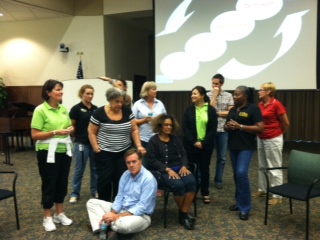
Here is a link to more details about their vision to enhance all teachers’ access to the arts and some photos from our day of Theatre for Critical Multicultural Education (thanks Pat!).  The photos showcase our work using Boalian techniques of Forum Theatre and Rainbow of Desire.  We asked ourselves many challenging questions including: how do we approach teacher education with candidates (many of whom are in their early twenties) for licensure who hold onto to racist, homophobic, sexist or other discriminatory views? We engaged in what Terry Tempest Williams refers to as “sacred rage” and what Freire and Boal refer to as dialogic pedagogies.

Image


ImageImage

Part IV: To create “contact zones” of human connection and differences in perspective

To create “contact zones” of human connection and differences in perspective [Part IV of Why Teachers Need the Arts (and the Arts Need Them!)


Mary LouisePratt’s (1991) introduced the concept of the “contact zone,” a term she used to refer to “social spaces where cultures meet, clash, and grapple with each other, often in contexts of highly asymmetrical relations of power, such as colonialism, slavery, or their aftermaths as they are lived out in many parts of the world today” (34). Pratt illustrates “the contact zone” through an analysis of a bilingual Quechua-Spanish manuscript, titled a “new chronicle,” dated in the city of Cuzco in 1613. The Andean author, Guaman Poma used a familiar colonial genre to agentively write his own story in his own words, “using the conqueror’s language” (Spanish) as well as his own (Quechua) as a form of self representation as well resistance and critique (35)—a chronicle that went unread for 350 years.


This process which Pratt (1991) defined as a transcultural contact zone, Gloria Anzaldúa (1987) had also theorized invoking the Aztecan term nepantla, a permanent in-between space where one dwells in collision—between languages, nation-states, sexual orientations, genders, and cultural assumptions.  While concepts such as nepantla and the “contact zone” have made an impact on university curricula, including major shifts to include ethnic and womens’ studies at campuses across the United States, a widespread assimilationist paradigm is still alive and well in terms of K-16+ English language norms and international/immigrant student education.  Educational institutions might be said to be part of Anderson’s (1991) “imagined communities” where solidarity is achieved on an “essentially imagined basis” (74) where standard English ability is both “code” and “Code,” a medium of communication as well as a symbol of genuine belonging.


Pratt’s (1991) chapter describes a search in education for “the pedagogical arts of the contact zone,” ways to create K-16+ and graduate school curricula which elicits and honors discourses of belonging and critique, attentive to agentive student demands: “I don’t just want you to let me be here, I want to belong here; this institution should belong to me as much as it does to anyone else” (39). Like Pratt (1991), Davis (2008) and many others, I join critical and aesthetic-minded educators in a turn toward the arts as powerful tools for establishing all students’ rights to participate fully in U.S. academic discourses—regardless of language, race, class, (dis)ability, or country of origin.  While classes in the literary, visual, and performing arts may have a positive effect on students’ L2 development and growth in academic subject matter learning, I am more invested in aesthetic ways of knowing which enable emerging artists to develop critical, transcultural voices.


Drafting poems, molding clay, rehearsing lines of music or a play—these actions require the student-artist to develop the fine art of “perspective.”  Student-artists share their art-making and discover the many different interpretations that might be brought to the same piece, those that may have been unexpected and that teach the artist something about her own work.  Serious art-making requires trial and error, considerations of others’ reactions, investments in aesthetic communication that respects and transcends difference.


In light of our rapidly changing demographics which will include increasing numbers of minority leaders in business, social services, government and other leadership, educators need to explore opportunities for classroom participants to share abilities to communicate across linguistic, racial, and cultural competences and social experiences to succeed in an ever more diverse world. Training in the arts can provide teachers (and their students) opportunities for rich and expansive understanding of diversity (Paris, 2012). As Davis (2008) articulates:

The arts provide ways for children to create and communicate their own individual cultures, to experience the differences and similarities among the cultures of family or nationality that are imprinted on different forms of art, and to discover the common features of expression that attest to a human connection contained in and beyond difference (pp. 22-3).


Teachers training in art-making processes experience the clash between what one thinks is being communicated and what is actually communicated—a reflexive muscle that can benefit classrooms where 32 students may hear 32 different sets of the same instruction.  Being able to hold up a piece of artwork to outside critique and perspective is like holding a crystal up to a piece of light.  Perhaps, such experiences may help us to see the confusion that comes with classroom diversity as a rainbow palette of possibility.

Why Teachers Need the Arts (and the Arts Need Them): Part III, A Lyric Container for Suffering

A Lyric Container: To have a productive place to put the burdens of our day

Being a teacher is not easy.  Children of all ages bring with them backpacks of incredible emotional complexity and varied lived experience.  I will be haunted to this day by a third grade student in my Los Angeles classroom in 1993.  I can still see Angelica’s small head of uncombed black hair asleep on the desk and the bruises on the backs of her slender folded arms.  When I asked her about the bruises she explained her sister beat her with a brush and she couldn’t sleep.  She also couldn’t read.  Angelica made my job a little bit harder each day and as a novice teacher in my early twenties I didn’t know what to do with that information.   I decided to march home with her and see the conditions of her life for myself.

I saw a small room of an apartment under the freeway, leftover chicken bones covered with flies, and an angry older sister left responsible for her siblings at too young of a teenage life.  Following the L.A. Unified School District rulebook, I did what I was supposed to do and alerted the Division of Family and Children Services to report the abuse.  When I saw Angelica the following days and weeks until the end of the year, I learned that whatever I had done, had only made things worse.  That was the end of my career as a teacher as I had decided there were too many burdens out of my control and I needed a place to put them, a container for reflection.  So at Twenty five years old, just three years after I had started my career as a teacher, I sat in the California Writing Project program for teachers at the University of Los Angeles when for the first time, a poetry instructor gave me permission to write.  The whole summer I was to write creatively and reflexively—not just about teaching but about my life, my failed dates, my running group, my hurried bowls of cereal before class.  The oppportunity for writing poetry inspired in me a new way of teaching, a workshop model where for the first time I was writing alongside the children—insisting on quiet and concentration so that at the end of the 20 minute third grade period we could share our stories, get feedback, and write our books.  Books weren’t easy to publish then, computer word processing was still new, there weren’t programs for layout.  We had to build our books and illustrations ourselves.  I was never so proud of a literacy assignment.  But this pride had come too late. I had already sent in applications to go to graduate school the following year and with emergent success and a container for the emotional cycles of a teacher’s day, I packed my L.A. apartment and headed for the red woods to start of my graduate studies at U.C. Santa Cruz and then across the country at the University of Pennsylvania.  But I was already addicted to the experience of making art with words.  Throughout my degree programs in education, I snuck the poems into my life. When I finally became a full-fledged professor, I gave myself permission in 2005 to take myself seriously as an artist. I finally felt I could afford to do it—I could afford the cost of such a program (at least I thought so! I was grateful for some lucky fellowships and prizes that defrayed the costs considerably), and I could afford the time.  I also felt I couldn’t afford not to—I needed to have a stronger poetry “container” to place my experiences as “witness” in educational contexts as well as in my personal life.

Thus, I signed up for a “low residency MFA” program where I could keep my job and over two years time work on my poetry during winter and summer breaks and during the academic year by mail with a mentor poet.  This M.F.A. program at New England College was a wonderful experience.  But I can’t help but wonder if I had had the opportunity to write creatively from the beginning of my teaching career, would I have been able to stay—emotionally, intellectually, physically— in that third grade classroom a bit longer and have written better, more urgent poems because of it?  We talk about teacher burn out and teacher shortages; we bemoan teachers stuck in their ‘old ways’ or new teachers who lack experience.  The arts can level the playing field, they invite all angles of experience and they provide a healthy container for reflecting on practice in order to remain in practice.  I don’t think writing poems would have fixed Angelica’s problems at home or mine as her teacher, but poetry might have given me a healthy place to grieve; a critical container for making connections between Angelica’s family situation and wider societal challenges regarding poverty, urban violence, neglect, and isolation.  I found a place to take my grief and uncertainty: poetry.  Unfortunately, I found that container when I had already decided to leave my classroom for the solace and thinking space of graduate school.  May more teachers have access to training in the arts in order to make poetic sense of the complicated experiences found in classrooms. Arts-integrated teaching and learning may provide greater opportunities to support teacher health and retention.

Why Teachers Need the Arts (and the Arts Need Them): Part II of More….

To maintain the element of surprise!

Teach a student to think about scripted lesson plans with prescibed outcomes, and the learning environment bores; stir up the air waves with music, theatre, poetry, or dance and suddenly it’s impossible to predict classroom outcomes. The arts act as a kind of unpredictable, oscillating fan—injecting welcome, unexpected breezes into what otherwise might be a very stale room (all the more so in my humid Georgia climate!). Training in the arts demands “the attention of current discovery,” the goal of the arts being to surprise the artist with new ways of seeing and being in the world that are, “as the etymology of the word ‘surprise’ literally states, beyond grasp” (Hirshfield, 2007, p. 28). 

“Surprise” is a challenging aesthetic quality for which to advocate in an educational climate that wants test score outcomes, and the certainty of measured knowledge.  But it is when teachers can be surprised by their students’ that the deepest forms of dialogic learning can occur.  Let me illustrate this by example.

The other day I ran a theatre workshop in the context of a graduate course titled “Academic Communication.”  The goal of this newly created course was for it to serve as an introduction to U.S. academic discourse (and TESOL discourse in particular) for newly arrived international students.  The premise of its design was that the instructor knows a great deal about academic communication skills students need, including how to write a summary, analysis, and critique; how to access and utilize U.S. library resources and communicate professionally in U.S.-based disciplinary organizations, online, and face to face with student peers and higher status professors. Despite my best intentions, there was a monologic undertone to this course’s creation, what Paulo Freire critiqued as “banking education,” the professor’s unidirectional “deposits” of U.S. academic ways into eagerly accepting international student “accounts.”

Freire’s (1970) critical pedagogy focused on the importance of dialogue between teacher and students, the exchange of knowledge whereby the teacher’s role is that of facilitator or guide, nurturing the teacher within each one of his or her students.

Given the more “academic” nature of the course I had withheld my arts-based proclivities until this, the 6th week in the 15 week semester—after all, didn’t I need to focus on more concrete, stylistic features of academic writing? Was there time for the arts? But at this near-midway point in the semester I began to feel a need to get to know the students in academic communication in arts-based ways that didn’t just view them as deficient and in need of more expert academic English communication skills. The arts didn’t have to replace the goal to review the specifics of academic communication, from linking verbs to Western definitions of plagiarism and correct structures for writing an academic email.  I wanted to add the arts, so that both my students and I might feel more alive and engaged, connected to the original potential of our thoughts and spirits. 

In the spirit of creating academic community I invited other graduate students and faculty to join us for a dialogic class session using theatre games. I introduced “Yes, No, Stop, Dude,” a game that asks each player in the circle to start with saying the word “Yes” in repetition but to express it in a “new way” each time the turn is passed to another member of the class.  We were only 5 turns into different expressions of “Yes” (said seductively, affirmatively, ecstatically, hesitantly) when we arrived at “Xuelai,” a masters student from China who has struggled in oral and written participation.  There was an uncomfortable pause which I read as uncertainty.  I was tempted to give Xuelai “an answer,” concerned about the delay in our game.  As I began to doubt the uncomfortable pause, she lifted a humble shoulder and placed an imaginary receiver to her ear. “Yes?” she uttered.  In that moment, I was elated.  While I was relieved the game could continue, I was also struck by her unexpected and novel improvisation which I hadn’t before considered.

As each student took a turn, I was continually renewed by this feeling of surprise—receiving answers I could not have possibly predicted and learning something about each person’s creative and spontaneous process. This kind of surprise is an awakening to the marvels of what students produce that is not required or scripted, and goes beyond expectations to teach the instructor something new. I believe the experience of adding artistic ways of knowing and relating to one another to the academic classroom environment, initiates a qualitative shift in the relationship one has with one’s students and the relationships students have with each other.

This theatre game example may seem like too small a surprise to celebrate but it served me as a reminder, yet again, of the importance of creating classrooms spaces that feel like co-creations and leave both student and teacher feeling renewed and refreshed by the unexpected.  When I teach what it means to summarize an academic article, I may be reminded that there may be as many ways to do this as there are ways to saw the word “Yes” around a circle.  My hope is that I can continue to maintain that feeling of surprise as students’ submit their academic writing for the course grade.

This is not to say that I won’t teach Xuelai and her peers techniques I know work for paraphrasing an article in one’s own words, analyzing and critiquing its contents.  But I hope to do so in ways that allow the students to surprise me with their insights and approaches, lifting an imaginary receiver that also asks me to reconsider my ways of knowing in the academy and what might shift when newcomers from faraway lands become co-constructors of academic knowledge.

Teachers at all levels, infants to adults, need the arts to train ourselves to delight in moments of surprise, to cultivate classrooms where students feel they are active participants to collaborative learning. We need ongoing practice in letting go of singular right answers.  The arts remind us how much value there can be from maintaining the element of surprise so that we learn how much we don’t yet know about each student and their marvelous other identity as “teacher” in our classrooms.


Freire, P. (1970). Pedagogy of the oppressed. New York: Herder and Herder. 

Hirshfield,  J. (2007). Poetry & the constellation of surprise. Writer’s Chronicle 40 (2), 28-35.